
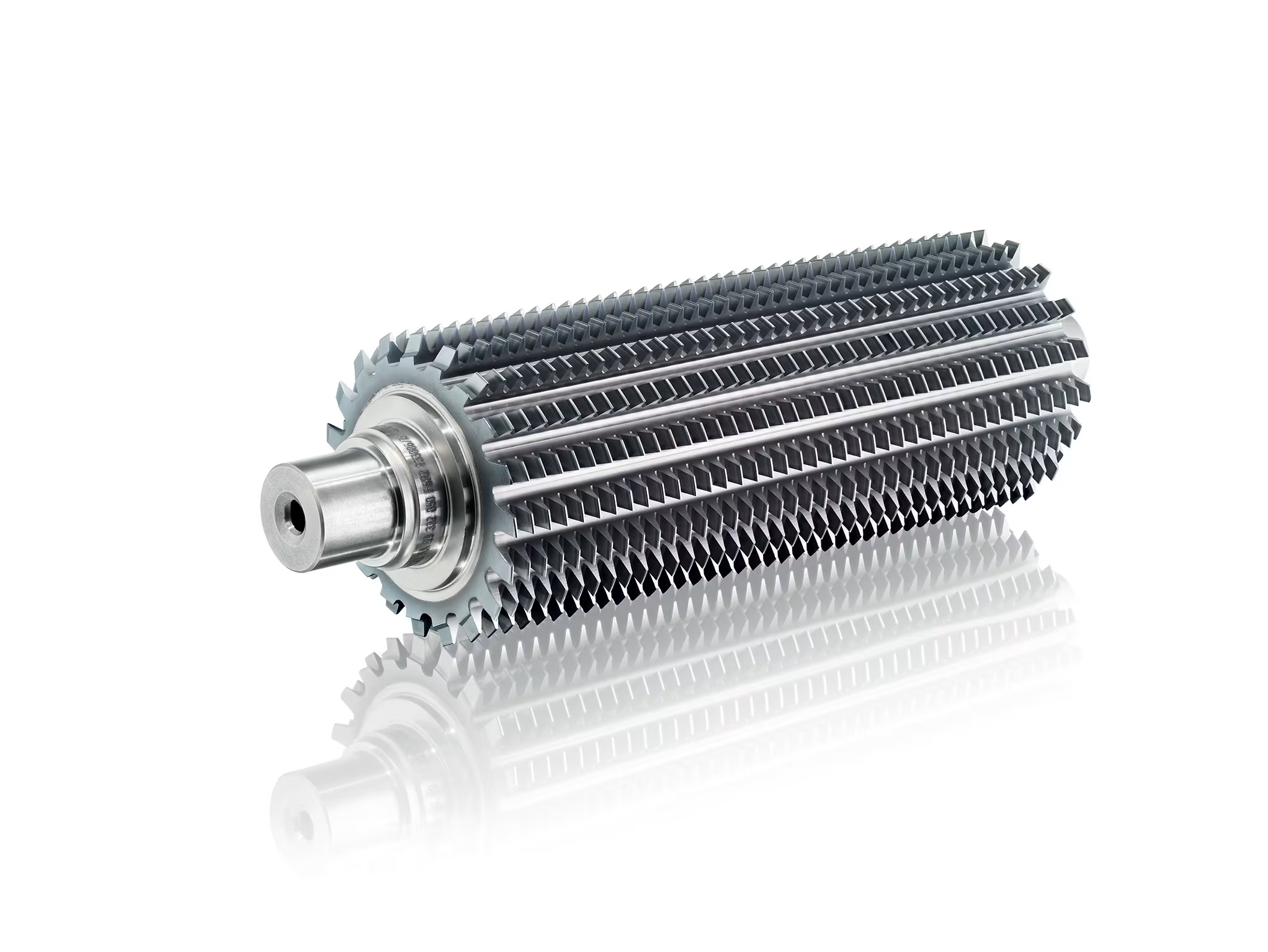
SpeedCore Hob Cutters: Performance Meets Cost-Effectiveness
Up to 50 percent higher cutting speeds
Schwarzenbek, may 7, 2026 -The current market situation is putting pressure on companies that rely on carbide tools: Rising raw material costs, volatile supply chains, and limited predictability are weighing on the industry. FETTE Werkzeugtechnik, a member of the LMT Tools family and a specialist in gear cutting tools, offers the SpeedCore milling cutter as a high-performance and cost-effective alternative. The innovative gear hobbing cutter is made of a specially developed high-performance high-speed steel and enables cutting speeds up to 50% higher than those of conventional PM-HSS tools, while maintaining high process reliability.
Carbide tools offer high performance but are heavily dependent on critical raw materials such as tungsten and cobalt. For users, this means that tool costs and availability are currently difficult to estimate due to the tight raw material and supply situation. This uncertainty can become an economic risk, particularly in mass production. That is why the focus is shifting to cutting material concepts that combine high productivity with greater cost and supply stability. One solution is the SpeedCore from FETTE Werkzeugtechnik.
Innovative Material Concept The hobbing cutter is made of a specially developed high-performance high-speed steel and bridges the gap between conventional PM-HSS (powder metallurgical high-speed steel) and cemented carbide. Its unique properties result from precisely controlled intermetallic phases that improve the cutting material’s hot hardness and thermal stability. As a result, the SpeedCore withstands higher thermal loads and enables higher cutting speeds than conventional PM-HSS tools. At the same time, the cutting material offers the necessary toughness for reliable, process-safe operation. Users can significantly increase productivity on existing equipment while simultaneously reducing unit costs, without having to invest in new machines.
Process Expertise as a Key Performance Factor In addition to the material, process expertise also determines whether SpeedCore fully realizes its technical and economic potential. FETTE Werkzeugtechnik views machining as a comprehensive system comprising the tool, workpiece, machine, and machining strategy. The process parameters are individually tailored to the material, component geometry, machine kinematics and stability, as well as the thermal and mechanical boundary conditions. “Unlike generic parameter recommendations, LMT Tools designs solutions specifically tailored to the material and application. The goal is to utilize the most cost-effective process window in each case without compromising process reliability,” emphasizes Raphael Lienau, Managing Director of FETTE Werkzeugtechnik GmbH & Co KG.
Machining time reduced by approximately 50% In an application for manufacturing a gear with a module of 9 for a planetary gearbox in mining machinery, a SpeedCore end mill with a Nanosphere 2.0 coating was pitted against a TiN-coated tool made of EMo5Co5, a cobalt-alloyed high-speed steel (HSS-E). The result: Machining time dropped from 50.9 to 26.2 minutes. This corresponds to a reduction of approximately 50%. With this, the SpeedCore is entering performance ranges that were previously reserved for multi-piece tools with carbide cutting edges. The one-piece design offers additional advantages in terms of accuracy, tool costs, and effective number of teeth.
Efficient Gear Manufacturing SpeedCore is a high-performance and cost-effective alternative for applications in which cemented carbide is not always the optimal solution due to cost, availability, or process considerations. At the same time, the gear hobbing cutter demonstrates how innovation in materials science and in-depth process expertise can help address current challenges such as cost pressure, dependence on raw materials, and limited predictability in gear manufacturing. “The key strength lies not only in the material itself, but in the ability to specifically adapt it to application-specific processes. It is only through this integration that real added value is created for the user,” says Raphael Lienau.